Showing posts with label OldSolarSystem. Show all posts

Tuesday, September 22, 2020

57 Hours Left for Vintage Worlds Kickstarter

The Kickstarter for Vintage Worlds 2 & 3 has a little over two days left. It is coming down to the wire as to whether it will fund or not. Cross your fingers, tentacles, pseudopods, or other equivalent appendages!

Vintage Worlds is a series of anthologies of retro-style sci-fi short stories. By retro sci-fi, I mean rockets and ray-guns, sword-fights by the light of the twin moons on the canal-banks of Mars, dangerous forays into the humid jungles of Venus teaming with ultra-tropical alien life, unscrupulous smugglers and pirates haunting the Asteroid Belt, and so on. That is to say, the Solar System as it should have been, as opposed to the one we actually got. It is a really interesting sub-genre of science fiction if you ask me -- and who wouldn't want to ask me?

Volume One of Vintage Worlds turned out really well, I thought. Help us bring Volumes Two and Three to life!

Wednesday, September 2, 2020

"The Sarcastic Snake-Men of Neptune" To Be Published in Vintage Worlds 2

Very exciting news! The long-awaited Kickstarter for Vintage Worlds volumes 2 and 3 has begun at last. My short story-- actually closer to novella length-- titled "The Sarcastic Snake-Men of Neptune" will appear in volume two. If you have read the first installment of VW, you may remember my story, "The Headless Skeletons of Mercury". Two characters from "Headless" appear in "Sarcastic," but it is not necessary to know the story of "Headless" in order to understand and enjoy "Sarcastic." I mention it only because if you liked plucky heroine D.J.'s Mercury shenanigans, you'll probably enjoy a much longer story seeing her get into trouble on a trip to Neptune.

And perhaps I am a vain person, but the awesome cover art of volume two could very well have been inspired by "The Sarcastic Snake-Men of Neptune" (which does contain a scene on a moon of Jupiter), although in my mind, D.J. doesn't look at all like that haha.

Monday, January 28, 2019

The Best Views in the Solar System (Handy-Dandy Reference Chart)

NOTE: The following originally appeared on Solar System Heritage. I am reposting it here taking some feedback/corrections into account, and also cleaning up formatting, etc.

I am working on a story whose opening scene is planned to be on Callisto with a view of Jupiter. When writing this scene, I thought, wouldn’t it be nice to know about how large Jupiter looms in Callisto’s sky in real life, to give my story just a touch of extra-gritty realness? Or, for that matter, to know how big all the various bodies of the Solar System appear when viewed from the other bodies?

Unfortunately, I couldn’t find a reference chart with this info. So, I have started putting one together myself. I am not a math person by any stretch of the imagination, but I know how to google haha. I found that to calculate the apparent size of something, one uses this fairly simple formula…

arctan(diameter/distance) 

“Diameter” is the diameter of the object you are looking at. “Distance” is how far away it is. “Arctan” is a trigonometry function (inverse tangent); just look for a website that will calculate arctan for you. Easy-peasy, space-lemon-squeezy.

Applying this formula will get you a number in degrees (or radians if you prefer), and one can get a sense of how this big or small something appears by using the same formula on common objects seen at arm’s length and comparing your results to each other.

Below is a table of views of various objects in the Solar System by vantage point and approximate apparent size when viewed therefrom, using the formula. As noted above, math is not my strong suit, so my calculations may very well be far off of the reality. (Note: I added a few inches to the average length of the human arm to account for the fact that "arm's length", in this context, is the distance from your eyes to your fingertips rather than shoulder to fingertips.) 

One thing to keep in mind is that, in real life, most people grossly overestimate the apparent size of objects in the sky. If you ask a random person how big the moon appears in the Earth's night sky, they will frequently say something like “a dinner plate” or “a softball” or even “a basketball”, but that isn’t even close to correct. In fact, you can easily hide the moon behind the tip of your pinkie finger held at arm’s length. One can only imagine what people would think of seeing something that actually does hang in the sky like a basketball, like Mars as seen from Deimos, let alone larger, like Saturn as seen from Mimas!

View of the Sun (865,000 miles diameter)
  • from Vulcan (assuming ~20 million miles from the Sun): about two and a half degrees -- a ping-pong ball held at arm's length
  • from Mercury (~42 million miles from the Sun): slightly more than one degree -- a U.S. penny (one-cent coin) or euro two-cent coin held at arm's length
  • from Venus: can't see the Sun on account of the thick clouds (in fiction, the Sun is generally assumed to cause a diffuse glow in the sky at least)
  • from Earth (~92 million miles from the Sun): about half a degree -- your pinkie fingernail held at arm's length (coincidentally, the Moon and the Sun have very nearly the same apparent size from Earth)
  • from Mars (~138 million miles from the Sun): about a third of a degree -- an average-sized green pea held at arm's length
  • from Ceres (~258 million miles from the Sun): about a fifth of a degree -- the head of a pin held at arm's length
  • from Neptune or Pluto (~3 billion miles from the Sun): about a sixth of a degree -- at this point, the Sun is not much bigger than a star, though still much brighter than a star (in fact, still bright enough to cause a twilight "day" in this part of the Solar System)
  • from Ultima Thule or Planet X (~4 billion miles from the Sun): about an eighth of a degree -- the Sun appears to be a bright star


View of Earth (7,926.3 miles diameter)
  • from Luna (about 238,000 miles from Earth): slightly less than two degrees -- the Earth appears about the size of a U.S. half-dollar coin or British 50p coin held at arm's length


View of Mars (4,212 miles diameter)
  • from Phobos (3,700 miles away): about 49 degrees -- about as big as a giant (90cm) beach ball held at arm's length
  • from Deimos (14,600 miles away): about 16 degrees -- a small watermelon held at arm's length


View FROM Mars 
  • of Phobos (diameter 14 miles): takes up about a fifth of a degree, or about as big as a pinhead held at arm's length (fun fact: Phobos rises and sets about twice per Martian day due to its crazy fast orbital speed)
  • of Deimos: it looks much like a star
  • of Earth and Luna: they can be seen, individually, with the naked eye from Mars (just as Mars can be seen from Earth with the naked eye); they look much like stars (fun fact: Luna is the only moon in the Solar System that can be seen with the naked eye from the surface of a planet other than its host)


View of Jupiter (~89,000 miles diameter)
  • from Io (about 217,000 miles away): about 22 degrees -- a big watermelon held at arm's length
  • from Europa (about 414,000 miles away): about 12 degrees -- a cantaloupe held at arm's length
  • from Ganymede (about 665,000 miles away): about 7 degrees -- a softball held at arm's length
  • from Callisto (about 1.1 million miles away): about 4 degrees -- a baseball or cricket ball held at arm's length


View of Saturn (74,500 miles diameter excluding rings; outer diameter of the "A" ring is about 170,000 miles) NOTE: Saturn's closest moons are lined up with the rings (indeed are part of the ring system), hence viewing them edge-on and from within, spoiling the view
  • from Mimas (115,000 miles from Saturn): Saturn itself takes up about 32 degrees of sky -- equivalent to a 55cm pilates balance ball held at arm's length
  • from Enceladus (148,000 miles from Saturn): Saturn itself takes up about 27 degrees -- equivalent to a medium-sized (45cm) beach ball held at arm's length
  • from Titan: Titan's thick atmosphere would probably obscure the view from Titan
  • from Iapetus (2,213,000 miles from Saturn):
    • Saturn itself takes up slightly less than two degrees in the sky -- about like a U.S. half-dollar coin or British 50p coin held at arm's length
    • The rings should appear to take up about 4 degrees of sky -- the diameter of a baseball or cricket ball held at arm's length (but disk-shaped instead of spherical, of course)
    • The orbit of Iapetus is such that it should get a decent view of the rings (i.e. not edge-on)
  • from Phoebe (~8 million miles from Saturn):
    • Saturn itself takes up about half a degree -- your pinkie fingernail held at arm's length
    • The rings should appear to take up about one and a quarter degree -- a bit smaller than a U.S. nickel (5-cent coin) or euro five-cent coin held at arm's length
    • The orbit of Phoebe is such that it should get a decent view of the rings (i.e. not edge-on), though it is kind of far away


View of Uranus (~32,000 miles diameter)
  • from Miranda (80,000 miles away): about 22 degrees -- a big watermelon held at arm's length
  • from Ariel (119,000 miles away): about 15 degrees -- a small watermelon held at arm's length
  • from Umbriel (165,000 miles away): about 11 degrees -- a cantaloupe held at arm's length
  • from Titania (271,000 miles away): about 7 degrees -- a softball held at arm's length


View of Neptune (~34,000 miles diameter)
  • from Triton (220,000 miles away): about 9 degrees -- a shot-put held at arm's length


View of Pluto (~1,473 miles diameter)
  • from Charon (3,161 miles away): about 25 degrees -- a medium-sized (45cm) beach ball held at arm's length


View FROM Pluto 
  • of Charon (750 miles diameter): about 13 degrees --a cantaloupe held at arm's length

Friday, September 21, 2018

I Was Completely Wrong...

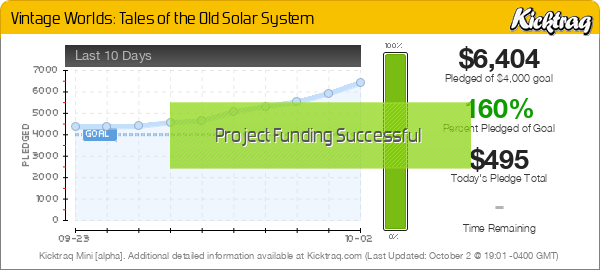
Vintage Worlds: Tales of the Old Solar System is funded! As of this writing it is at 105% of its goal. I was thinking it was going to come down to the last day or two of the campaign, but no. With 11 days still left to go, it has already blown past the funding goal by a comfortable margin. Woo!

Not sure where the big surge yesterday and today came from, but hey... whatever gets us over the finish line.

Thursday, September 20, 2018

Vintage Worlds 90% funded!

I am pretty stoked that, as of this post, the Vintage Worlds Kickstarter has reached 90% of its funding goal. Better still, we are still less than two-thirds of the way through the campaign. So, VW is on pace to fund. Yay!

I still think it will be close though. Looking at the KickTraq daily data, it's immediately obvious that the big bumps for us came on September 5 and September 19, not coincidentally being days when John Michael Greer posted about the campaign on his blog. Those two days alone account for about a third of the total funding pledged; clearly, this project wouldn't have got off the ground without his support. But, we probably aren't going to have another big bump from that source-- probably most JMG fans who were planning to pledge have done so already. To make it the rest of the way, we'll still need to average more than one new backer buying the $25 book per day for the remainder of the campaign.

Likely it will come down to the last 48 hours. If you "heart" a project on Kickstarter, when the clock strikes 48 hours till the end of that project's campaign, KS will send you an email saying something to the effect of, "last chance to back x project." And for some reason, many of the regulars on Kickstarter wait until they get those 48-hour notices before deciding whether or not to pledge on any given project. As a result, many KS projects get a major surge starting 48 hours before the close of the campaign. I predict our 48-hour surge is what will take Vintage Worlds over the finish line.

Vintage Worlds: Tales of the Old Solar System -- Kicktraq Mini

Tuesday, September 11, 2018

Vintage Worlds update

As of this post, the Vintage Worlds Kickstarter has passed 100 backers and reached about 60% of its funding goal. Or, put another way, a bit less than one third of the way into the campaign it is a bit less than two thirds of the way to its goal. So, that's a positive trend, but I still think it's going to be really close in the end. If book Kickstarters are anything at all like board game Kickstarters, there will be a huge lull for the middle third (or so) of the campaign, and people will start asking if it's completely stalled out. Still, for now, it's looking pretty good...


Vintage Worlds: Tales of the Old Solar System -- Kicktraq Mini

Wednesday, September 5, 2018

Vintage Worlds Kickstarter

The Kickstarter for Vintage Worlds has been live for a few days. Not sure if Labor Day weekend is really the best time to launch a KS campaign, but what do I know? It's up there now; go check it out! As of the time of this post, three days into the campaign, it is 33% funded.

The campaign got a big bump today from being promoted on John Michael Greer's Ecosophia blog. Hopefully that will be enough haha.

Friday, August 3, 2018

Vintage Worlds cover preview

Cover art for the upcoming anthology Vintage Worlds: Tales of the Old Solar System was released a few weeks ago. Why do I care about that? Why, because this book will contain my own short story, "The Headless Skeletons of Mercury", along with sixteen other tales. Interestingly, VWTOSS will, in fact, have stories taking place on all the planets of the Solar System, plus Sol, Luna, Pluto, and the Asteroid Belt. It wasn't planned out that way, I don't think-- certainly I had no idea what anyone else was writing when I decided to spin a yarn set on Mercury-- but it is pretty cool nonetheless to have all the major points of interest in the Solar System reppin'.

Also, this cover art by Matt Forsyth is dope, y'all.


Friday, March 9, 2018

The Headless Skeletons of Mercury to be published

Happy to announce that my short story, "The Headless Skeletons of Mercury" will be published in the upcoming anthology Vintage Worlds Volume One, a collection of stories about the "old" solar system (you know, the one where Mars had canals and ancient ruins, Neptune was an oceanic world, and Venus was covered in lush, dangerous jungles). It will be my fourth published story.

The formal announcement is here: http://www.solarsystemheritage.com/anthology-project-2017.html

Monday, January 22, 2018

Whither Ye Olde Solar System, Or the Electrum Age of SF

Had an interesting debate (if you want to call it that) via email with Zendexor of the Solar System Heritage website, a site devoted to "Old Solar System" literature (think canal-building sentients on Mars and lush jungles on Venus, surely a fun setting for short stories and novels, even if our understanding of the real-world solar system no longer can support such tales as anything other than fantasy).

The debate: should those who would write OSS stories today seek to incorporate not only the early 20th century's scientific understanding of the solar system, but also incorporate early 20th century values and cultural assumptions in their tales as well? The two answers to that question, yes or no, Zendexor has termed (respectively) the NOSS-R (for Neo-Old Solar System, Reactionary), and NOSS-T (for Neo-Old Solar System, Trendy). Which is preferable to readers and authors? Which would you prefer to read (or write)? Should a middle ground be sought?

Zendexor posted the debate online and a couple of other OSS authors weighed in with their thoughts as well. The debate is posted here.

SSH doesn't have comments turned on for most pages on the site, but anyone wanting to discuss this burning question further may comment here.